
Needle or cannula
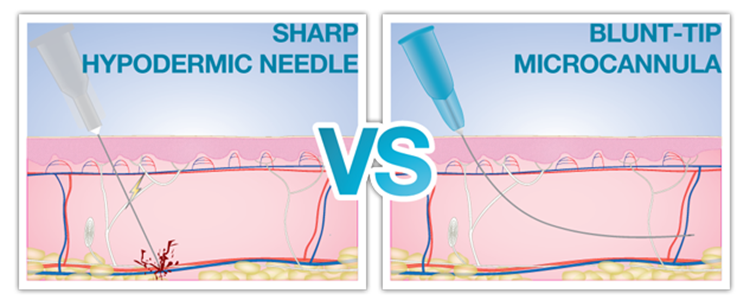
Traditionally, dermal fillers are injected using a hypodermic needle, however in recent years aesthetic cannulas have become more popular, especially for large areas of the face. Now some fillers are equipped with both a needle and a cannula, so that the cosmetologist has a choice of the method of drug administration. But how exactly does a practicing cosmetologist choose between the two methods of carrying out the procedure? In this article, we will explain the main advantages and disadvantages of needles and cannulas and highlight the differences between them.
Perhaps the most obvious difference between a needle and a cannula is that the tip of the needle is sharp while the cannula is blunt. One of the main concerns when using a dermal filler needle is the potential for swelling and bruising after the procedure. Once the needle is inserted, there is a chance that it will damage the blood vessels under the skin, resulting in bruising. Although estheticians can use their knowledge of facial anatomy to minimize the risk of bruising, even the most experienced practitioners cannot guarantee that a patient will not experience bruising. On the contrary, the cannula minimizes the risk of bruising due to its blunt end. Although a small diameter needle is used as the initial entry point, once the cannula is inserted into the skin, it is much less likely to be punctured and pass through the blood vessels. Instead, it simply repels vessels, causing less trauma under the skin and therefore less chance of bruising after the procedure.
Another risk associated with the sharp end of the needle is not only piercing the blood vessel, but actually injecting the filler into it, which leads to blockage of the vessels, and can lead to much more serious complications. Again, there are a number of measures that beauticians take to prevent this from happening, but this possibility must be considered when using a needle.
The risk of vascular occlusion is one of the reasons many practitioners prefer to use the cannula in "high risk" areas, such as around the eye, because, unlike a needle, the cannula does not puncture blood vessels in this area . and is less likely to cause serious complications.
Another important difference between needles and cannulas is that the cannula is much longer than the needle and is more flexible. Its length and flexibility means that the cannula provides a smoother, more continuous delivery of filler to areas such as the jawline. This is very good for patients who are nervous about needles as far fewer injections are needed. The cannula requires only a small number of insertion points, covering much larger areas and making the procedure less painful. On the other hand, needle, being shorter and stiffer, must pierce the skin several times in order for the filler to spread over the entire treated area.
While most estheticians consider the flexibility and length of the cannula to be one of the main advantages, some also consider this a disadvantage. A small needle often provides more control and precision, especially in areas where high precision is required. An example of this is the treatment of fine "smoker's wrinkles"; around the lips when a light hand is required to precisely inject a small amount of filler. In this case, the cannula simply will not allow you to provide the same level of control.
Ultimately, the benefits of both methods depend on the treated area and, in some cases, on the patient. As well as personal preference. Some estheticians feel more confident when doing most filler procedures using only a needle or only a cannula, while others may switch between the two on a case-by-case basis. Most professionals will agree that the cannula is a useful skill, even if they don't use it very often.
